
Adapt every digital touchpoint to regional context with geo-targeted merchandising and localized offers.
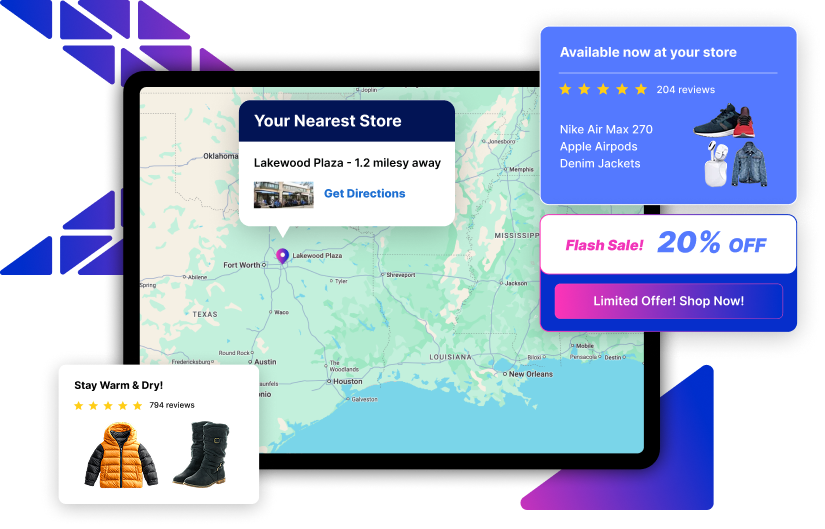
You've built a strong retail presence. Hundreds of stores across multiple markets. Local teams running promotions. Store managers managing inventory. Regional marketing campaigns.
But your website shows the same experience to everyone,
everywhere.
Your stores are assets. But if your website doesn't connect online traffic to local inventory, you're losing the benefit.
Many customers prefer buy online, pickup in store (BOPIS), but they can't see what's available at their local store, so they either order for shipping (lower margin) or buy elsewhere.
Your regional teams invest in local promotions, store events, and community engagement. Your website doesn't amplify any of it. Money spent on local marketing that your digital presence ignores.
Customers visit your website, see "ships in 5-7 days," and then check Amazon or drive to a local competitor who can fulfill today. Your three-mile proximity advantage becomes irrelevant.
Online traffic that could drive foot traffic just bounces instead. Your stores have inventory, but online visitors don't know it exists. Digital cannibalizes stores instead of feeding them.
Showing winter coats to Miami customers or patio furniture to Seattle customers in December creates friction. Wrong products for the wrong climate equal higher bounce rates.
Imagine a different reality.
A customer in Chicago searches for a product on your website. The product page shows "In stock at Chicago Lincoln Park - 2.1 miles away - Pick up today" with a map and store hours. They can reserve it online and pick it up in an hour.
A visitor within 10 miles of your Seattle store sees a homepage hero banner featuring rain gear and outerwear—because it's raining in Seattle right now. The merchandising adapts to local weather conditions hourly.
A Texas customer visiting your site this week sees a prominent banner: "Texas-only: 20% off boots this weekend." The promotion is geo-fenced to Texas residents only.
A customer in the NYC metro area lands on your homepage and sees "NYC Store Grand Opening - This Saturday - Exclusive Offers" as a homepage takeover. The promotion only shows to visitors within the event radius.
Your product recommendations prioritize items available at the visitor's nearest store. If it's in stock locally, it gets promoted. If it requires shipping, it gets deprioritized for customers who prefer same-day pickup.
Every visitor sees store-specific inventory, local promotions, weather-appropriate merchandising, and geo-fenced offers. Your website becomes an extension of your local store network instead of competing with it.
Instant IP-based location detection identifies which store is nearest to each visitor. Manual store selector override lets customers choose their preferred location. Cookie persistence remembers "my store" for return visits.
Nearest store calculation integrates with your store location database. Distance displayed in miles or kilometers. Store hours, phone number, and directions built in.
Real-time inventory API integration shows store-level product availability on product detail pages. Alternative: batch sync updates 1-4 times daily for retailers without real-time APIs.
Low-stock urgency triggers: "Only 3 left at [Store Name]." BOPIS eligibility calculation: "Available for pickup today at [Store Name]." Products that aren't available locally get filtered or deprioritized in recommendations.
Real-time local weather data (temperature, conditions, forecast) drives content decisions. Weather-triggered merchandising rules: if temperature below 50°F, feature outerwear; above 75°F, feature summer categories.
Seasonal adjustments by hemisphere and climate zone. No more showing winter products to Phoenix customers in July.
Regional promotion targeting by city, state, DMA, ZIP code, or custom radius from stores. Store-specific offers: "Free same-day delivery within 15 miles of [Store Name]."
Local event promotion: Only show store opening announcements or community events to visitors within the event radius.
Hero banners personalized by region and weather. Category page merchandising adapts to local climate. Product recommendations filtered by store inventory and local trends.
 44%
44%
A national retailer with 200+ stores across 38 states was seeing online traffic bounce while stores had inventory available. The website showed generic content with no connection to local stores. Customers would check online, see "ships in 5-7 days," and either order from competitors or abandon them entirely.

How do you connect hundreds of stores to a single website without creating separate site versions for each market?

Monetate deployed geo-targeted personalization with store inventory integration and weather-responsive merchandising. The homepage began showing local store inventory, regional promotions, and weather-appropriate products based on visitor location.

Geo-targeted retailer saw 44% higher CTR on geo-personalized hero banners vs. generic.
The retailer has since expanded the geo-personalization framework to 12 additional markets in 6 months, using templated regional rules that deploy in 1-2 weeks per new market.
Customer in Chicago views a product. Product page displays: "In stock at Chicago Lincoln Park (2.1 mi) - Pick up today" with an embedded map showing store location and current hours.
Seattle visitor on a rainy day sees homepage hero featuring raincoats, umbrellas, and waterproof boots. Phoenix visitor on the same day sees homepage hero featuring outdoor furniture, cooling products, and summer apparel.
Texas residents see a banner at the top of every page: "Texas-only: 20% off boots this weekend - In stores and online." Customers outside Texas never see this offer.
Customer in Chicago views a product. Product page displays: "In stock at Chicago Lincoln Park (2.1 mi) - Pick up today" with an embedded map showing store location and current hours.
Visitors in the NYC metro area see a homepage takeover: "NYC Store Grand Opening - This Saturday - Exclusive In-Store Offers + Prize Drawings." Only shows to visitors within 50 miles.
Product recommendations engine prioritizes items that are in stock at the visitor's nearest store. Local availability becomes a ranking signal alongside purchase history and browsing behavior.
Import store locations, hours, contact info via CSV or API. Configure distance calculation logic and store selector interface.
Deploy regional homepage variations based on geography and weather.
Set up real-time inventory API integration (if available) or batch feed sync (1-4 times daily). Configure low-stock thresholds and BOPIS eligibility rules.
Category pages and recommendations adapt to local climate conditions.
Connect to weather data provider (Monetate provides default integration). Set up weather-triggered content rules.
Launch store locator enhancement showing nearest store and inventory availability.
Deploy regional homepage variations based on geography and weather.
Category pages and recommendations adapt to local climate conditions.
Batch updates work fine. Most retailers sync inventory 1-4 times daily. We display "as of [timestamp]" messaging to manage customer expectations appropriately.
Yes. You can display "in stock at nearby stores" even if customers can't complete online purchase for pickup. This drives foot traffic and phone calls from high-intent shoppers.
Manual store selector is always available in the interface. We also detect IP anomalies and default to national experience when location confidence is low.
City-level, ZIP code, DMA, state, radius from any store location (e.g., "within 25 miles"), or custom geo-fence polygons drawn on a map.
No. Set content rules once (e.g., "if temp <50°F, show outerwear category") and the weather API keeps it current automatically with hourly data refreshes.